Options
Terjemahan Kinayah Dalam Wacana Al-quran: Analisis Teori Semantik Newmark
Journal
E-Jurnal Penyelidikan dan Inovasi
Date Issued
2018
Author(s)
Nasimah Abdullah
Lubna Abd. Rahman
Saifullah Samsudin
Abstract
In the Qur'an, there are various types of figurative locutions and the Arabic
linguistics experts call them majāzi. A figurative phrase is a sentence that contains
an expression that can not be understood by the meaning of the word itself or from
its grammatical structure. Therefore, it should be clearly explained so that its true
meaning can be accurately conveyed. Kināyah is one of the figurative locutions
used to refer to an expression that does not imply its actual meaning. The purpose
of this study is to examine the translation of kināyah in the Quranic verses into
Malay based on Semantic Theory proposed by Peter Newmark in his book
"Approaches to Translation" (1981) to find out the equivalence in its meaning
between the Quranic text and the target text. This study utilized two approaches:
library research and qualitative approach. The forms of analysis used were
content analysis, contrastive analysis and descriptive analysis. Content analysis
focuses only on comparing "al-Quran Mushaf Malaysia dan Terjemahan"
published by Yayasan Restu and "Terjemahan al-Quran al-Karim Rasm Uthmani
Dalam Bahasa Melayu" published by al-Hidayah House of Quran Sdn. Bhd. To
measure the equivalence between the source language messages and the target
text, the researchers adhere to the interpretations by Muslim scholars in their
exegesis such as Al-Baydhāwi, al-Tabari, Al-Qurtubi, Ibn Kathir, Al-Zamakhsyari,
Ibn 'Asyūr and Ibn' Atiyyah. It is found that semantic approach could convey the
true meaning of the Quranic message as found in the translation of verse 47 Surah
al-Imran and verse 20 Surah Maryam. This is because there are similar meanings
through the same image between Arabic and Malay. However, in some instances
this approach could not deliver the actual meaning clearly and this would lead to
ambiguity, especially the translation of verse 222 Surah al-Baqarah, verse 9 Surah
Ibrahim, verse 51 Surah al-Isra ', verse 65 Surah al-Anbiya' and verse 4 Surah alMasad. This is due to the differences in linguistic characteristics, cultural elements
and semantic meanings between Arabic and Malay. Thus, translators should
choose appropriate approach when translating kināyah to deliver the message
from source text to target text so that the understanding of its true meaning can be
achieved
linguistics experts call them majāzi. A figurative phrase is a sentence that contains
an expression that can not be understood by the meaning of the word itself or from
its grammatical structure. Therefore, it should be clearly explained so that its true
meaning can be accurately conveyed. Kināyah is one of the figurative locutions
used to refer to an expression that does not imply its actual meaning. The purpose
of this study is to examine the translation of kināyah in the Quranic verses into
Malay based on Semantic Theory proposed by Peter Newmark in his book
"Approaches to Translation" (1981) to find out the equivalence in its meaning
between the Quranic text and the target text. This study utilized two approaches:
library research and qualitative approach. The forms of analysis used were
content analysis, contrastive analysis and descriptive analysis. Content analysis
focuses only on comparing "al-Quran Mushaf Malaysia dan Terjemahan"
published by Yayasan Restu and "Terjemahan al-Quran al-Karim Rasm Uthmani
Dalam Bahasa Melayu" published by al-Hidayah House of Quran Sdn. Bhd. To
measure the equivalence between the source language messages and the target
text, the researchers adhere to the interpretations by Muslim scholars in their
exegesis such as Al-Baydhāwi, al-Tabari, Al-Qurtubi, Ibn Kathir, Al-Zamakhsyari,
Ibn 'Asyūr and Ibn' Atiyyah. It is found that semantic approach could convey the
true meaning of the Quranic message as found in the translation of verse 47 Surah
al-Imran and verse 20 Surah Maryam. This is because there are similar meanings
through the same image between Arabic and Malay. However, in some instances
this approach could not deliver the actual meaning clearly and this would lead to
ambiguity, especially the translation of verse 222 Surah al-Baqarah, verse 9 Surah
Ibrahim, verse 51 Surah al-Isra ', verse 65 Surah al-Anbiya' and verse 4 Surah alMasad. This is due to the differences in linguistic characteristics, cultural elements
and semantic meanings between Arabic and Malay. Thus, translators should
choose appropriate approach when translating kināyah to deliver the message
from source text to target text so that the understanding of its true meaning can be
achieved
File(s)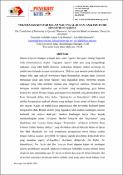
Loading...
Name
Terjemahan Kinayah Dalam Wacana Al-quran; Analisis Teori Semantik Newmark (The Translation of Metonymy in Quranic Discourse; An Analysis Based on Semantic Theory by Newmark).pdf
Size
679.32 KB
Format
Adobe PDF
Checksum
(MD5):b43f308bc4a9e85f96227f047f21670f